Ist Ihr Marketingplan auf Erfolg ausgerichtet? Verwenden Sie diese Checkliste, um es herauszufinden.



It’s crunch time for marketing teams, with 75% of CMOs facing pressure to do more with less. But in the quest to drive revenue, a great marketing plan isn’t always enough—it’s how you implement it that matters. In this article, learn how leaders can put their annual plans into action and ensure every campaign is set up to drive revenue growth, without wasting valuable time and money in the process.
3 Möglichkeiten, Marketingkampagnen mit Asana schneller zu starten
Verbinden Sie Gympass mit Asana, um zu erfahren, wie Sie Stakeholder aufeinander abstimmen, die Leistung in Echtzeit überwachen, manuelle Prozesse automatisieren und vieles mehr.

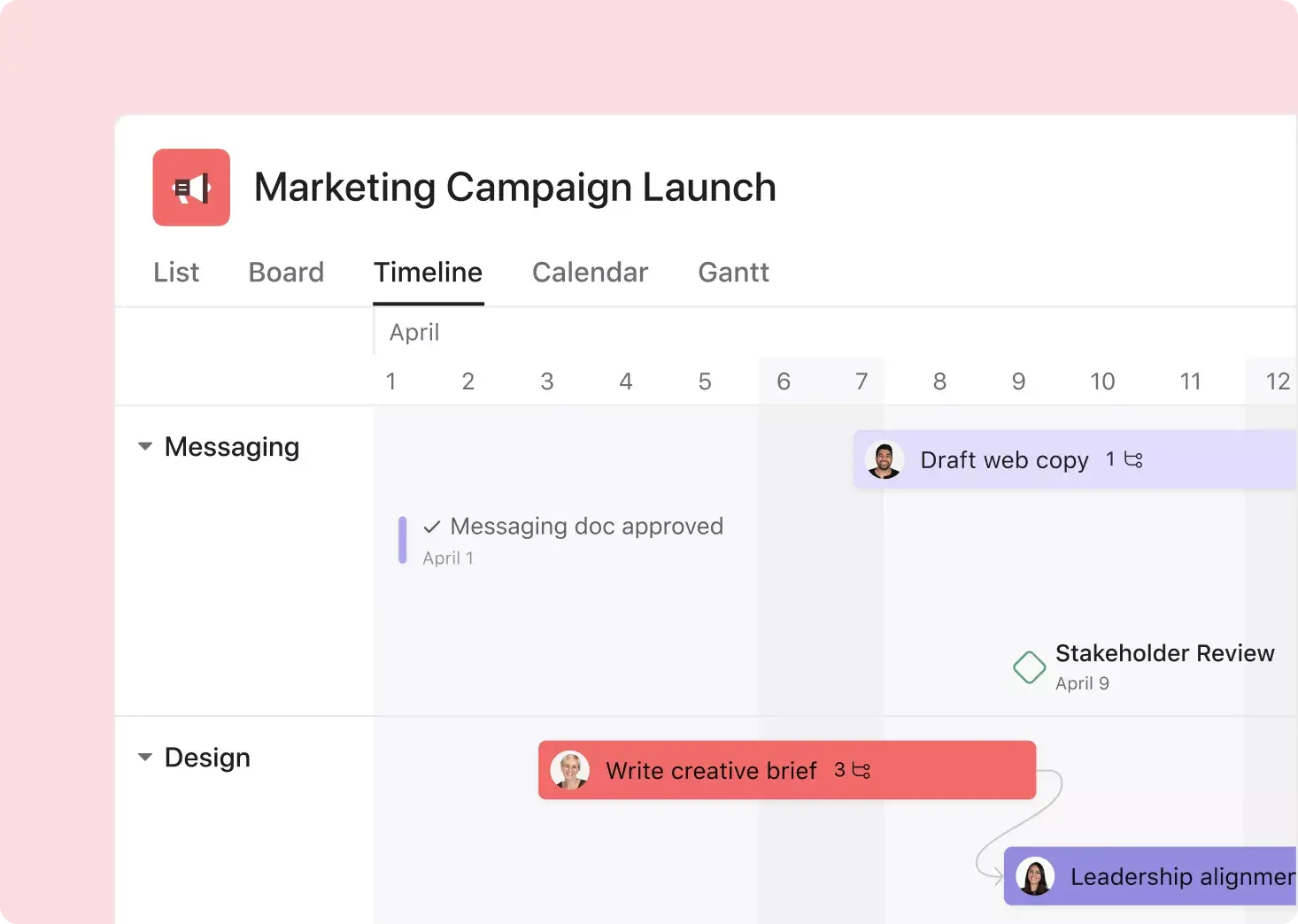
1. Align marketing and sales with shared goals
Only 23.1% of sales professionals say sales and marketing are strongly aligned. But it doesn’t have to be that way. By rallying marketing and sales teams around shared goals, you can break down silos and ensure everyone is working in the same direction.

Um als Marketingexperte erfolgreich zu sein, müssen Sie die Pipeline und den Umsatz liefern.”
For shared goals to work, a few different things have to happen:
Marketing and sales decide on the key metrics they’ll use to measure success—like revenue or closed deals. By keeping those metrics consistent across teams, you ensure everyone is aiming for the right targets.
Both teams align on their ideal target audience, so all efforts are spent in the right place. For example, this could mean mapping marketing campaigns and sales tactics to specific buyer personas.
Teams make their shared goals visible across the organization—so both marketing and sales stay accountable and on track. For example, leaders can use work management software to ensure every sales tactic and marketing campaign ladders up into shared goals.
Fallstudie: Arbeitsvorgänge mit Zielen verknüpfen bei Lucid
Lucid nutzt die Ziele -Funktion in Asana, um die OKRs des Unternehmens nachzuverfolgen und sie mit den Aufgaben der einzelnen Angestellten zu verknüpfen. So wird sichergestellt, dass jede Initiative einem Business-Ziel zugeordnet ist. Die Programmmanager stellen sicher, dass die Teams in jedem Quartal neue OKRs erstellen und diese während des Quartals aktualisieren, damit die Arbeit nach Plan verläuft.
2. Set actionable targets
Despite the importance of goals, 90% of executives at companies with annual revenues of $1 billion fail to reach all their strategic objectives because they’re too difficult to implement. Closing that gap between goal setting and implementation is essential for marketing success—and leaders can solve this by making every campaign goal actionable.
One way to create actionable goals is with objectives and key results (OKRs)—a goal-setting methodology that pairs objectives with the metrics teams use to track progress. OKRs follow this simple but flexible template: “I will [objective] as measured by [key result].” In this format, the objective is the goal you want to achieve, while the key result is the metric you’ll use to measure progress.
Fallstudie: Ziele bei Asana
Das Führungsteam von Asana legt Business-Ziele fest, aber einzelne Teams erstellen Key Results, um sich an diesen Zielen auszurichten. Anschließend legt jedes einzelne Teammitglied seine eigenen Schlüsselergebnisse fest, die wiederum mit denen des gesamten Teams im Zusammenhang stehen. Dieser Ansatz gibt den Angestellten einen Nordstern, auf den sie hinarbeiten können, und stellt sicher, dass alle Arbeiten mit den wichtigsten Geschäftszielen zusammenhängen. Aber Führungskräfte (denen oft das Gesamtbild fehlt) müssen nicht zu viele Vorgaben machen. Stattdessen können Teams und Einzelpersonen ihre eigenen Ziele festlegen und verfolgen.
3. Communicate your plan
If your marketing plan stays in a drawer to gather dust, it’s not going to yield results—period. Employees need visibility into company and marketing team objectives, so they know how to plan and prioritize campaign work. Despite the importance of communicating goals, it’s still a challenge for many leaders. According to our research, only 16% of employees say their company is very effective at setting and communicating goals, and only one quarter of employees say they have a very clear understanding of how their work relates to company goals.
Technology, like work management systems with built in OKR features, solves this by enabling everyone to see business goals and visualize how their work ladders up into those top-level objectives. That means the leadership team doesn’t need to spend lots of time and effort to guide workers in the right direction. Instead, marketers have enough information to guide themselves—choosing on their own the best way to support your marketing plan.
Forschung im Fokus: Daten zur Zielsetzung von Führungskräften aus dem Work Innovation Lab
4. Track goals and course-correct
It’s critical for leaders to adjust their strategy as conditions change. Shifting marketing conditions, new competitive threats, and other internal and external factors can put goals at risk—or even open up new areas of opportunity. Without a system to track and adjust goals, leaders can’t monitor the situation and adjust their strategy. They’re like a pilot flying blind, following a pre-set course despite changing weather and air traffic patterns.
Here’s how marketing leaders can successfully track and course-correct goals:
Document goals in a central place, so every team can see what your starting targets are. Having a record is especially important if you need to shift goals later.
Decide on a regular reporting and status update cadence to keep teams informed on progress. For example, check and share your goal progress every month for a quarterly objective.
Share status updates in one place, so teams can see a record of progress over time. Ideally, stakeholders should be able to find and look through past status updates whenever they need to.
Decide in advance who is responsible for updating goals if market conditions change. Creating a decision-making framework ahead of time ensures teams carefully evaluate any changes, especially when those changes will impact the entire marketing organization.
Forschung im Fokus: Daten zur Zielverfolgung von Führungskräften aus dem Work Innovation Lab
5. Keep teams accountable
Setting, communicating, and tracking goals is one thing, but how do you ensure work stays on track once it’s assigned out across the marketing org? Keeping teams accountable is one of the greatest challenges when it comes to delegating work, but it’s doable with a bit of extra structure. The key is to clearly define roles and responsibilities, so everyone knows exactly what they should be doing.
Here are a couple different frameworks you can use to keep teams accountable:
RACI charts: A RACI chart clearly identifies a project team’s roles and responsibilities. By following the acronym, you can clarify who’s in charge of what—so there’s less confusion and you can move forward decisively. The acronym stands for: Responsible, Accountable, Consulted, and Informed.
RAPID® decision-making: While a RACI chart defines project roles, the RAPID® framework assigns roles for the decision-making process itself. The framework identifies five key roles for major decisions: Recommend, Agree, Perform, Input, Decide.
Fallstudie: Verantwortungsbereiche (Areas of Responsibility, AoRs) bei Asana
Wenn Mitarbeiter einen AoR haben, bedeutet das, dass das Unternehmen ihnen vertraut, die Arbeit so voranzubringen, wie sie es für richtig halten – solange es in ihren spezifischen Bereich fällt.
So verbessert Asana mit Work Management Kampagnen
Erfahren Sie, wie das Marketingteam von Asana die Beteiligten aufeinander abstimmt, indem es die Kampagnenplanung und -produktion zentralisiert.
Turn your plans into action
You’ve put a lot of work into annual planning—now it’s time to turn those plans into revenue-driving campaigns. For more actionable insights, check out our webinar about how to create a successful marketing plan for 2024.
3 Möglichkeiten, Marketingkampagnen mit Asana schneller zu starten
Verbinden Sie Gympass mit Asana, um zu erfahren, wie Sie Stakeholder aufeinander abstimmen, die Leistung in Echtzeit überwachen, manuelle Prozesse automatisieren und vieles mehr.